The Bottle
The Bottle
The Finding
The drum needed three minutes to wind. She counted them in her hands rather than her head — the resistance building against her palm as the spring tightened — and noted the time by the lamp room clock: 04:02. She opened the log.
Tuesday 3 November 1953. 04:00 winding complete. SW gale overnight, backing W by 03:00, now light NW. Sea running, foam on boulder shelf. Clear. Lamp steady.
She had come up in darkness to a lamp room full of noise: the drum ticking, the beam sweeping the black water below, the wind finding the lantern gallery vents in thin whistled intervals. By the time she finished the entry the wind had dropped another point. She could tell by the quality of the whistle.
She stood at the east-facing glass. Below, the swell was still running — long rollers from the northwest shredding against the cliff base in bursts of white that were gone before the lamp came round again. The boulder shelf would need checking. She went downstairs to dress.
She pulled the oilskin from the hook by the cottage door and put it on over her jersey and dungarees. The cottage smelled of coal smoke and yesterday’s lamp-oil rinsing. She took the torch from its shelf, lit it, and went out.
The cliff gate was iron, cold and damp, the hinge stiff with salt. She unlatched it and stepped onto the iron stair. The stair was bolted into the basalt and descended forty meters in a series of short landings. A southwest storm left it in the lee, so what she found this morning was a surface coating of spray residue, slick but manageable. She kept both hands on the rail.
The sky was beginning to separate from the sea. Not light yet, but less dark. She could make out the white lines of the swell below without the torch.
At the foot of the stair the boulder shelf opened out. The cliff drain had taken a tangle of dried gorse and one length of frayed line; she pulled both free and checked the drain was running clear. The mooring ring was intact, pin still seated. She played the torch along the base of the cliff face and found one new slab of rock, small, well clear of the stair foot. She noted it to log later.
She turned to go back up.
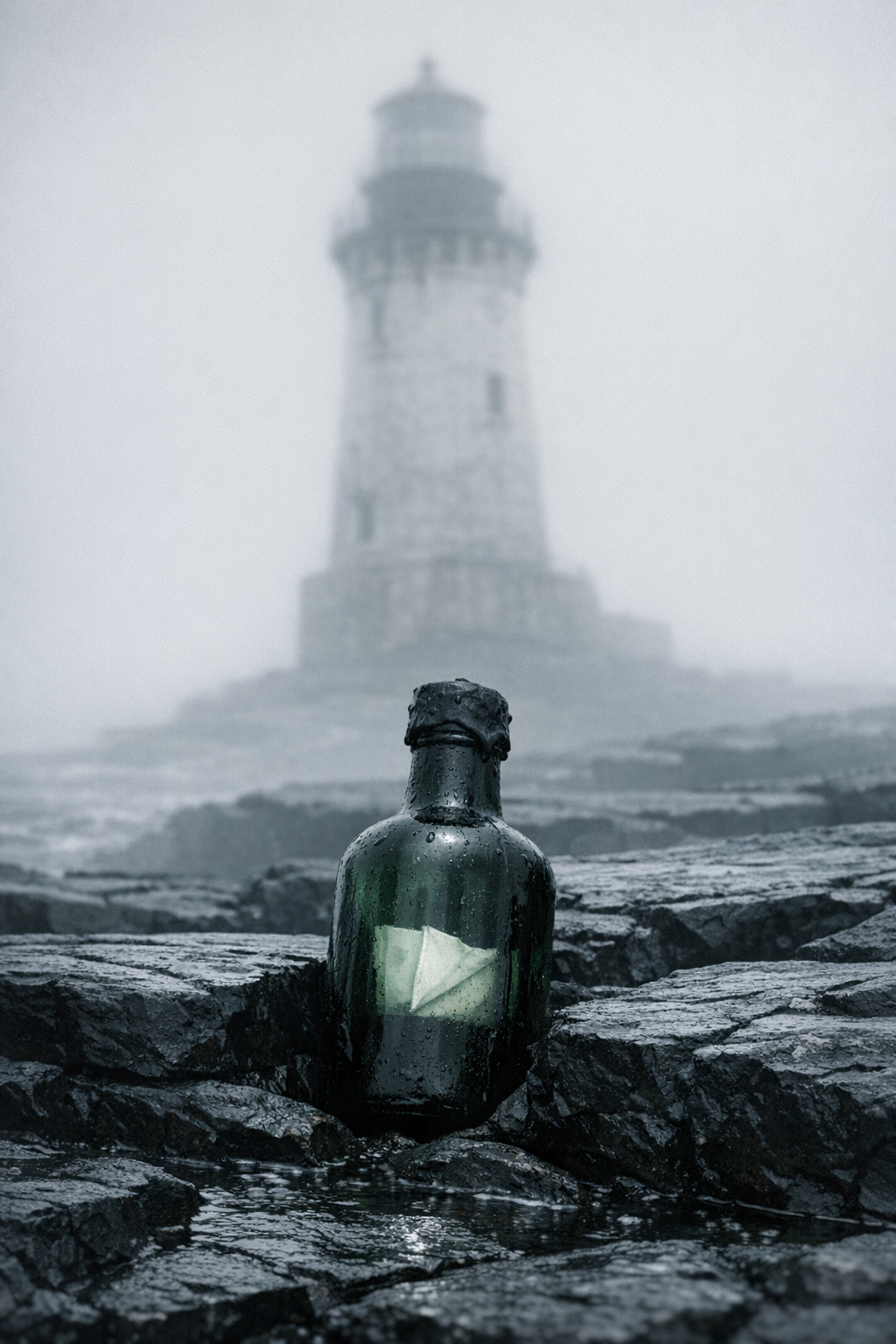
The bottle was two meters from the stair foot, lodged in a crack in the basalt at a height she had not checked on the way down. It had not been there before the gale; she knew the face of these rocks. It was glass, green glass, not large — perhaps thirty centimeters, a little less — with a cork seated in the neck and a wax seal over the cork. The wax was the color of old candle tallow. Not red, not recent. The bottle sat in the crack at an angle, as though something had placed it with some care for balance.
She picked it up. It was heavier than expected. She turned it in the torch beam. The wax seal was intact, no cracking, no sign of immersion damage. Inside, behind the green glass, she could see a tight roll of paper.
She put the torch in her coat pocket, held the bottle against her torso inside the open front of the oilskin, buttoned it partway, and climbed the stair with both hands on the rail.
She set the bottle on the logbook table and hung the oilskin. She put the kettle on the range. She sat and looked at the bottle in the light of the oil lamp.
She found her pocketknife and opened the small blade and cut around the wax at the bottle neck, the way she would open a Board of Lights notice. The wax came away nearly in one piece. She worked the cork with the knife tip and it came free with less resistance than she expected, as though it had been seated for a known time and was ready.
The paper inside was dry. She turned the bottle over and the roll dropped into her palm. She unrolled it on the table.
She recognized the handwriting before she had read a single word. The particular form of the letter r — a gesture in two strokes, not three, a habit she had never corrected. The hard black full stop at the end of each sentence. The slight leftward lean of her capital T. The spacing between words, which was slightly too wide, and which she had kept since she was twelve years old.
She read the message.
Three short lines and a closing instruction. She read it a second time. The kettle began to knock on the range.
The first line said the Morven would come on Tuesday, not Wednesday, and that the forward crate would have a cracked demijohn.
The second and third lines described other things. Not large things. They were precise enough that she could not write them off as coincidence if they occurred, and ordinary enough that she could not disprove them in advance. She looked at the lines again, at the hand that had written them. There was the r. There was the T.
The closing instruction told her to write this message, seal it in the bottle with the wax, and put the bottle back in the crack at the stair foot. It did not say when.
She sat with the paper open on the table until the kettle reached a full boil. Then she stood and made the tea.
She did not write anything in the log. She did not switch on the radio.
She rolled the message carefully and eased it back into the bottle. The cork seated with a light push. She left the cut wax in a small heap on the table and carried the bottle to the drawer under the logbook — the one where she kept the spare mantles, three of them wrapped in their paper sleeves — and laid the bottle on its side among them and closed the drawer.
The second winding was at 08:00. She climbed to the lamp room and wound the drum and noted the time. The beam swept the water in its four-second interval. The sea was gray and largely flat now, only a low swell from the northwest, the foam patches from the night dispersing.
She stood at the east-facing glass for a minute past what the winding required. The iron stair was visible below, and the boulder shelf at its foot, and the line of basalt where she had found the bottle. From this height she could not see the crack.
She went back downstairs.
The Interval
The barometer on Wednesday read 30.1, steady. She wound the drum at noon, at four, at eight in the evening, and the reading held each time she passed the instrument.
On Thursday it rose a point. She recorded it.
On Thursday afternoon she found herself re-folding a log entry from the day before. The fold was wrong, the paper not aligned squarely at the corner. She read the entry — 08:00 winding complete. Light NW. Barometer steady — and the entry itself had no error in it. She refolded it and replaced it in the ledger.
That evening she opened the drawer beneath the logbook table. The bottle was on its side among the three mantles in their paper sleeves, where she had left it. She looked at it and closed the drawer.
At 18:00 on Friday she switched the radio on for the weather bulletin. The bulletin came through cleanly: a high-pressure system stalled to the northwest, no fronts expected for seventy-two hours. She noted it in the log. The bulletin ended. She sat with her hand near the transmit key. The set hissed. She did not transmit. She switched it off and put the pen away.
She heard the Morven on Tuesday morning before she saw it. The engine note came from the south, the low and slightly uneven rhythm she had catalogued, over nine years of fortnightly calls. She was writing the 08:00 entry when she heard it.
She checked the clock. The Morven was due Wednesday.
She capped the ink and went to the jetty.
Cal brought the boat alongside and made her fast at the bollard without ceremony. He was in the short-billed cap he wore in all weathers.
“Channel was clear. No point in waiting.”
She nodded. He handed the first crate over the rail and she set it on the boards. They fell into the unloading without dividing it — he worked the forward hatch while she stacked, and then they walked the heavier crates to the store.
The forward crate was heavier than the rest. When Maren lifted it, water seeped through the bottom boards in a thin seam. She put it back down and opened the lid.
One of the two fresh-water demijohns had a crack along the shoulder of the glass. The cork had held, but pressure had worked through somewhere; the bottom of the crate was wet and the water inside the demijohn smelled of the hold. She lifted it out and carried it to the jetty edge and tipped it. The water fell in a glassy sheet.
“That’s the forward one,” Cal said. He had come up beside her.
“Cracked at the shoulder. Water’s turned.”
He looked at it. “I’ll note it for the Board.”
“I’ll note it in the log,” she said.
They shifted the remaining crates to the store. She went inside and put the kettle on.
Cal talked. There had been a squall north of the outer reef on the way out, broad enough that they’d had to come south around it, which had added half an hour. There was a ketch at the mainland yard being re-keeled — old timber, not worth the cost in his view, but it wasn’t his boat. There was a Board notice in the mail packet, something about the paraffin pressure specification; she’d want to read it.
She filled the mugs and handed him one. She stood at the table with her own.
“How was the crossing before the squall?” she said.
“Fair enough. Wind backed before we were halfway.”
“Aye.”
She signed the delivery receipt. Cal drained his mug and set it at the near edge of the table without being asked — the same place he always put it, within her reach. He pulled on his oilskin.
“All right then,” he said.
She walked him as far as the jetty. He untied the Morven, stepped aboard, and had the engine running before the line was fully coiled. She watched the tender move out from the jetty and begin the turn south. It rounded the reef. The engine sound carried a few minutes after the boat had gone from sight.
She went back inside and opened the logbook.
Supply delivery, Tuesday 10 November 1953. Morven, Cal Dresh, master. Departed 10:48. Coal (four sacks). Lamp oil (forty litres). Tinned goods (see inventory). Fresh water — two demijohns; one cracked at shoulder, discarded.
She listed the tinned goods and noted the Board notice on the side table, unread. She recorded Cal’s departure time. She drew a single line through the cracked demijohn in the inventory column.
Then she opened the drawer.
She took the bottle out and set it on the table. It sat in the lamplight, heavy, inert. She did not unroll the message. She knew what the first line said. The Morven had come on Tuesday. The forward crate had held a cracked demijohn. She put the bottle back and closed the drawer.
She woke on Wednesday at a few minutes past two.
Not to sound. To the wrong quality of quiet, and then to a clicking from the lamp room overhead that arrived in wrong intervals. She was dressed and on the stairs.
In the lamp room the beam was rotating but had slowed. She could see it in the movement of the lens, the interval between sweeps lengthening by a fraction. The drum had lost tension. She set her oil lamp on the bracket and felt along the winding gear with both hands. The third tooth on the upper ratchet had slipped from its seat.
The lamp was still burning. She checked all four quadrants of the gallery glass. No vessels in any direction.
She worked the tooth back by feel, pushing against the resistance of the mainspring until it seated with a small give, and wound the drum back to full tension. The lens picked up speed. She counted four sweeps against the lamp room clock. Four-second interval. Correct.
She noted the time: 02:14.
She stood with the drum ticking and the beam moving steadily above her and counted back. She had not been counting during the repair. She counted now: finding the fault, approximately four minutes; re-seating the tooth and winding, approximately six; checking the interval, two. Twelve minutes. The message had said twelve.
She went downstairs and wrote in the log:
02:14 — drum slipped, tooth re-seated, lamp on station throughout. Duration of repair approx. 12 min.
She looked at what she had written. She put the pen down.
She did not open the drawer. The third had not.
The Writing
The day’s log entry was already written when she made tea. Barometer 29.8, wind NW at 3, sea slight, lamp steady. She had checked the barometer at 18:00 and again at 19:00 and the reading had not moved. She did not check it a third time. She filled the kettle and set it on the range.
The bottle was on the logbook table where she had put it that morning: in the center, above the day’s entry, alongside the pen she had placed beside it and then capped again. She had not unrolled the message. She took her tea to the table and sat.
She turned the logbook back. The drum-slip entry — 02:14, tooth re-seated, twelve minutes — then the Morven delivery, then the post-gale inspection in which she had cleared the cliff drain, noted the new rock slab, and carried a glass bottle up the iron stair inside her oilskin. Eleven pages. All in her hand, all in the same format. She read each entry the way she would check a lamp part. She turned forward to the current page and left the book open.
She stood up for coal.
The barometer hung on the passage wall between the two rooms. She bent to read it on her way past and straightened again. The needle had moved. She looked at the clock: 19:49. She looked at the barometer again. The pointer was still moving, traveling across the face the way a tide turns — so slowly you had to look away to be sure it was moving at all.
She filled the coal scuttle. She rinsed the mug. At 20:00 she climbed to the lamp room and wound the drum — three minutes — and checked the rotation. Correct. She stood at the east-facing glass before going back down. Below, the boulder shelf was dark and she could not see it.
At 20:43 she bent to the barometer again. 29.52. She had read 29.82 at 19:49. She stood with the two figures settling. Fifty-four minutes, three-tenths of an inch, and still falling. She went to the logbook table and sat down.
She opened the supply drawer on the left side of the table and took out a sheet of Board correspondence paper. Unlined. She set it to the right of the bottle and uncapped her pen.
She unrolled the message. The paper was worn at its folds now — handled daily the first week, less after the drum slip, not at all the past four days. She smoothed it flat against the table and read each line, top to bottom. She re-rolled it and set it beside the fresh sheet and bent the lamp closer.
She began to write.
Tuesday the tender arrives a day early. The forward crate will hold two demijohns; one will be cracked at the shoulder.
She wrote it the way she had written it: same line spacing, same slight left-tilt to the capital T, the r made in two strokes, hard full stop.
Near 02:00 the clockwork drum will lose tension. Third tooth, upper ratchet. Twelve minutes to reseat.
She did not hurry. The pen had to go where hers had gone.
The barometer will fall three-tenths in under one hour.
She set the pen down and picked up the original and held the two sheets side by side in the lamp’s reach. Three lines, same spacing. The ink on the original was a shade darker — years in low light, sealed against what she could not name — but the letters were the same. Not similar. The same two-stroke r. The same hard stop at the end of each line. She set the original down.
She wrote the last line.
Fold this, roll it tight, seal it in the bottle, and place it in the crack in the basalt at the foot of the iron stair, above the high-tide line.
She folded the sheet twice and rolled it tight against the table edge. She slid the roll into the bottle and seated the cork. From the supply tin she took a stub of sealing wax. She held the end over the oil lamp’s flame until it softened and ran, then tipped it over the cork. Yellow wax, old tallow. She pressed it flat with her thumb and held it there until it firmed.
She put on her oilskin and took the torch from the bracket by the passage door. She put the bottle inside the oilskin, against her ribs. The stair rail needed both hands.
The night was still, the swell quiet. The boulder shelf at the foot of the stair was mostly dry. She crossed to the crack without searching for it: basalt slab face, two meters from the stair foot, a horizontal split she could fit two fingers into. She seated the bottle shoulder-first — the same way she had found it — and checked it with the torch. Seated, stable. The wax seal above the tideline. She straightened and clicked the torch off and stood in the dark a moment, then climbed back.
At the top she latched the cliff gate and went inside.
At the logbook table she opened the book to the current page and wrote: 20:00 — drum wound, lamp on station. Barometer 29.4 and falling. Wind backing SW. Sea moderate.
The original message was still on the table. She looked at it once. She carried it to the range and opened the door and set the paper on the coals and watched until the edges caught and the lines darkened and curled, and then not even the shape of them remained.
She closed the range door.
Wind pressed under the cottage door. The clockwork clicked in the lamp room overhead. The swell ground low against the rock below. The range ticked as the fire settled. The lamp turned in the tower.